
What Is RCS Messaging?
RCS is SMS rebuilt for the smartphone era—branded senders, read receipts, interactive buttons, and verified identity, all in the native messaging app. Here's the plain-English breakdown.
Sean
If you've been hearing more about RCS lately, you're not alone. It's become one of the most talked-about topics in business messaging, and for good reason. But the explanations out there tend to either get too technical too fast or stay so vague they don't actually tell you anything. This is the plain-English version, covering what RCS is, how it works, what it can do, and why businesses are moving to it right now.
The Short Answer
RCS stands for Rich Communication Services. It's a messaging protocol built to replace traditional SMS (Short Message Service), running over internet data instead of the traditional cellular network. Think of it as SMS rebuilt from the ground up for the smartphone era: better media support, read receipts, typing indicators, verified sender identity, and interactive elements like buttons and carousels—all delivered through the native messaging app on a user's phone.
No app download required on the recipient's end. No third-party platform to sign up for. Just a much more capable version of the text message, available inside the default messaging experience people already use every day.
The protocol itself has been around since the early 2010s, developed and standardized by the GSMA, the industry body that oversees global mobile standards. It took years to reach meaningful adoption because it required buy-in from device manufacturers, carriers, and operating system developers simultaneously. That alignment has now happened, which is why RCS is moving from a niche concept to a mainstream channel.
Why SMS Needed Replacing
SMS was designed in the 1980s. It was built for short, plain-text messages on 2G networks, with a 160-character limit that dates back to a study of postcards and telex messages. For decades, businesses used it anyway because the reach was unmatched. Nearly every phone on the planet could receive an SMS, and open rates were extraordinarily high compared to email.
But the limitations are significant and structural. There's no native way to verify who sent a message. A scammer and a major bank look identical in an SMS thread: just a phone number or an alphanumeric sender ID with no verification behind it. There's no read receipt. You can't send a high-quality image without it getting compressed into something barely recognizable. You can't include a clickable button. Every business message ends up as a wall of text with a URL, and users have been trained by years of phishing attempts to distrust exactly that format.
MMS extended SMS slightly by allowing multimedia attachments, but it inherited the same trust problems and added its own: inconsistent carrier support, heavy compression, and a user experience that varies wildly across devices.
The result is that SMS, despite its reach, has become a channel associated with friction and skepticism. Businesses kept using it because the alternatives required recipients to download an app. RCS changes that calculus entirely.
How RCS Works
At a technical level, RCS messages are delivered over IP (internet protocol) rather than the traditional cellular SMS network. This is the same underlying shift that enabled apps like WhatsApp and iMessage to offer richer experiences, but RCS does it within the native messaging layer of the operating system rather than requiring a separate app.
When a user's device and carrier both support RCS, messages are automatically upgraded from SMS to RCS. The user doesn't configure anything. From their perspective, they're just texting. The difference is in what they can see and do within that conversation.
For business messaging specifically, RCS operates through a system called RCS Business Messaging (RBM). This is a defined framework for how companies send verified, branded messages to consumers at scale. It includes the verification infrastructure, the agent profile system, the API layer, and the guidelines that govern what businesses can and can't do within the channel.
Businesses don't connect to this infrastructure directly. They work through an approved RBM partner, which manages the technical relationship with carriers and submits verification on the business's behalf. Once verified, the business gets a persistent sender identity that travels with every message they send.
What RCS Actually Looks Like
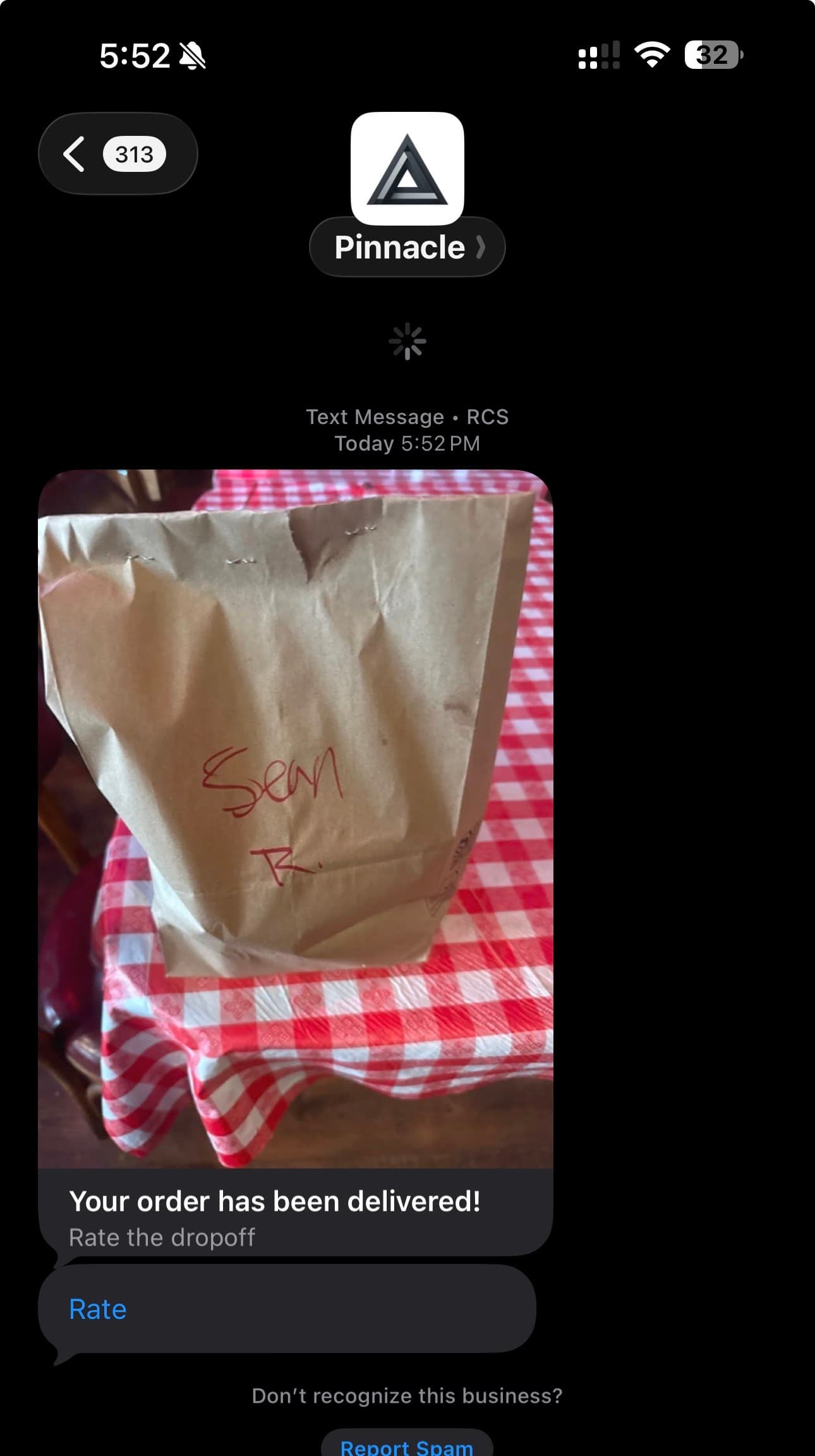 An example of RCS for business
When a business sends an RCS message, the recipient sees something closer to an app experience than a text message. Here's what that includes:
- Branded sender profiles. Your business name, logo, and brand colors appear at the top of the conversation thread from the very first message.
- Verified checkmark. A visual indicator that your business has gone through identity verification, distinguishing your messages from spoofed senders or spam.
- Rich media. High-resolution photos, videos, GIFs, and audio files delivered natively without the compression that degrades MMS attachments.
- Rich cards. Structured message formats that combine an image, title, description, and action buttons in a single visual unit.
- Carousels. A horizontal scrollable row of rich cards, ideal for showing multiple products or offers in a single message.
- Suggested replies. Predefined response options that appear as tappable chips below the message, lowering friction for conversational flows and surveys.
- Call-to-action buttons. Buttons that trigger specific actions: open a URL, dial a phone number, share a location, or open a calendar event.
- Persistent menus. A menu that stays visible throughout the conversation, giving users access to common actions at any point.
- Read receipts and typing indicators. Real-time signals so you know when a message was delivered and read.
- Two-way conversation. Users can respond naturally, tap buttons, or complete actions directly within the thread.
All of this happens inside the default messaging app—Google Messages on most Android devices, and the native Messages app on iPhone (iOS 18 and later).
RCS for Businesses Specifically
For businesses, RCS represents a fundamentally different kind of channel.
The verified sender system addresses the trust gap that has plagued SMS for years. When a recipient sees your logo and a verification checkmark before they even read the message, the credibility of that message changes entirely. They're not trying to figure out if the sender is legitimate. The question is already answered.
The interactive features change what a message can accomplish. Instead of sending a link and hoping someone taps it, you can present a carousel of products with purchase buttons, send an appointment reminder with a one-tap confirm or reschedule option, or walk a customer through a support flow without them ever leaving the message thread.
This matters across virtually every category:
- E-commerce. Product discovery, abandoned cart recovery, order confirmations, and delivery updates all benefit from rich media and interactive buttons.
- Financial services. Transaction alerts and fraud notifications carry more weight when they come from a verified sender with your bank's branding.
- Travel and hospitality. Boarding passes, check-in prompts, and itinerary updates are natural fits for rich cards with real-time content.
- Healthcare. Appointment reminders with confirm and reschedule buttons, prescription notifications, and patient follow-ups.
- Retail and restaurants. Loyalty program updates, promotional offers with product imagery, and order-ahead flows.
Across use cases, RCS campaigns consistently outperform equivalent SMS campaigns on open rates, click-through rates, and conversion. The experience is more trustworthy, more visual, and more actionable.
Where RCS Works Today
RCS has been widely supported on Android for several years. The bigger recent development is iOS. Apple added RCS support in iOS 18, released in late 2024—effectively closing the last major gap in RCS reach. Previously, any message to an iPhone fell back to SMS. That's no longer automatic for iOS 18 users.
Global coverage is still uneven by country, but for businesses primarily messaging customers in the US, UK, and other markets with strong carrier adoption, the addressable RCS audience is now large enough to treat as a primary channel.
RCS and SMS aren't mutually exclusive either. Well-built messaging systems handle the fallback automatically: send as RCS where supported, fall back to SMS where it isn't. Businesses can adopt RCS without abandoning SMS reach.
RCS vs Other Messaging Channels
WhatsApp and OTT apps can do many of the same things in terms of rich media and interactivity. The key difference is distribution. WhatsApp requires the recipient to have the app. RCS works through the native messaging app with no account or download required.
iMessage is Apple-only and closed. RCS is an open, cross-platform standard that works across Android and iOS without locking businesses into a single ecosystem.
Email has the richness but not the reach or open rates of messaging. The inbox is a crowded, filtered environment.
RCS sits in an unusual position: the reach and native delivery of SMS, combined with a feature set that approaches what OTT apps offer, without requiring anything extra from the recipient.
How Businesses Get Access
Individual businesses don't connect directly to the RCS infrastructure. You work through an approved RCS Business Messaging partner, which handles the technical layer and submits your verification on your behalf. Once verified, you get a persistent agent profile and access to the full RCS feature set—that verified identity travels with every message you send.
On the technical side, sending RCS through an API-based provider looks similar to sending SMS: you're making API calls with message content and recipient numbers. The difference is in the payload, which can now include structured rich card objects, button arrays, and media references rather than just text strings.
The time from starting verification to sending your first live RCS message is typically days to a few weeks, not months.
The Bottom Line
RCS is what SMS should have been. It takes the reach and native delivery that made SMS the dominant business messaging channel and layers on top of it the trust, richness, and interactivity that modern consumers expect.
For businesses still relying entirely on SMS, RCS is the most direct upgrade path available. You're reaching people through the same channel, in the same app, with no friction on the recipient's end. The difference is in what you can say, how you can say it, and whether people trust that it's actually you saying it.
Android support has been solid for years. iPhone support arrived with iOS 18. Carrier infrastructure is in place across the major markets. The businesses that move now will build channel competency and verified brand presence before it becomes table stakes.
Want to see how Pinnacle fits your stack? Book a 30-minute call with one of our engineers — we'll walk through your use case and get you live.