
Google RCS for Business: The Infrastructure Behind the Next Generation of Customer Messaging
When businesses send an RCS message today, they are almost certainly routing it through Google's infrastructure. Understanding what Google RCS for Business actually is, how it is architected, and what it means for enterprise communication decisions requires looking beyond the feature list.
Sean
When businesses send an RCS message today, they are almost certainly routing it through Google's infrastructure. That is not incidental. It is the result of a decade-long strategy by Google to own the backbone of the next global messaging standard. Understanding what Google RCS for Business actually is, how it is architected, and what it means for enterprise communication decisions requires looking beyond the feature list and into the platform logic underneath.
What Google RCS for Business Is (and What It Isn't)
RCS (Rich Communication Services) is a GSMA-defined protocol, representing an emerging industry standard. It is an open standard, not a Google product. But in practice, Google has become the dominant infrastructure provider for RCS globally, and its commercial layer, officially named RCS for Business (previously RCS Business Messaging, or RBM), is the primary mechanism through which brands send A2P (Application-to-Person) messages over the RCS channel.
The distinction matters for procurement and architecture decisions, and is often addressed in FAQs. Businesses do not contract directly with Google to send RCS messages in most cases. They access RCS for Business through certified messaging partners: aggregators and CPaaS providers who are registered in Google's partner program and have API access to the RCS for Business platform. Google defines the standards, operates the infrastructure, manages sender verification, and controls channel access. Partners handle billing, integration, and delivery.
In September 2025, Google formally retired the RBM acronym. The platform is now referred to externally as RCS for Business. This is a naming change only. No technical modifications were made to the platform or its APIs.
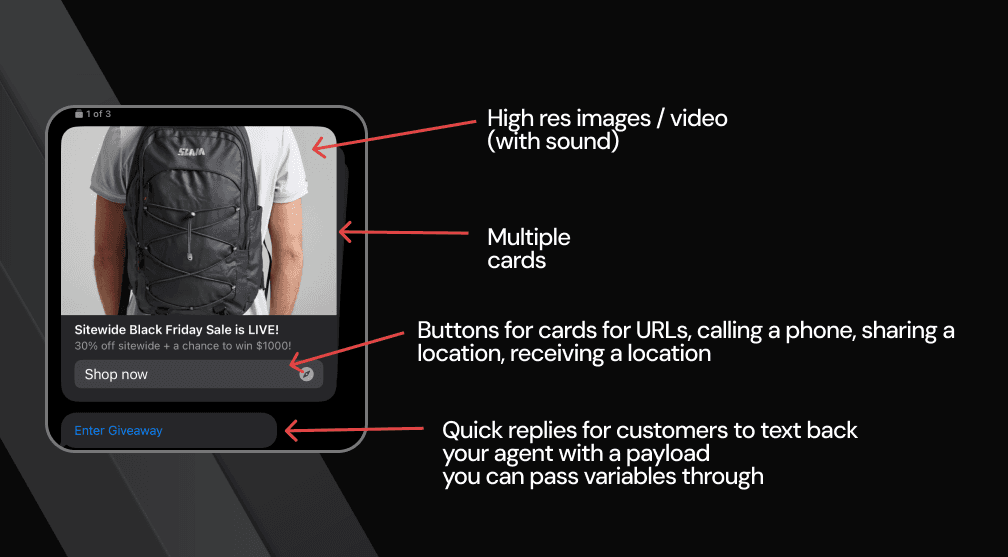 What RCS for Business looks like
The Jibe Platform: Google's Carrier Infrastructure Layer
Google's position in the RCS ecosystem is built on two interlocking components: Jibe Cloud and Jibe Hub.
Jibe Cloud enables carriers to launch and manage RCS services using Google-hosted infrastructure rather than building and maintaining their own IMS (IP Multimedia Subsystem) deployments. This dramatically lowers the cost and complexity of RCS rollout for mobile network operators, and in exchange, it places Google at the center of message routing for those networks.
Jibe Hub provides interoperability between separate RCS networks, whether carrier-hosted or Google-hosted, so that a message sent from one network reaches recipients on another without protocol fragmentation.
The carrier adoption of Jibe has been substantial. In the US market, AT&T and T-Mobile signed Jibe partnerships in 2021-2022. Verizon completed its migration to Google's Jibe backend in early 2024, retiring its proprietary RCS implementation. The result is that all three major US carriers now route RCS traffic through Google infrastructure. Internationally, carriers including O2 UK, Deutsche Telekom, and operators across Asia-Pacific have followed the same path. By 2025, Jibe-based carrier deployments have become the norm rather than the exception globally.
For businesses, this consolidation has a practical implication. The fragmentation that previously made RCS unreliable, caused by different carriers running incompatible RCS implementations, has been largely resolved. The Google Messages app is now the default messaging application on Android devices in the US market, and Samsung discontinued preloading Samsung Messages on Galaxy devices sold in the US starting in 2024, creating a clearer distinction from Apple's iMessage. Users can easily open Google Messages to access these features. RCS delivery through Google's stack is the de facto standard on any Android phone, including the Pixel.
iOS 18 and the Completion of Universal Reach
The structural limitation of RCS for A2P deployment was always iOS. Apple's exclusion from the RCS ecosystem meant that any brand running RCS campaigns had to maintain parallel SMS infrastructure for iPhone users, who represent roughly 55% of the US smartphone base.
Apple added RCS support in iOS 18, released September 2024. RCS messages are now delivered natively through the Apple Messages app on iPhones, displayed with the same green bubble treatment as SMS text messages, similar to how RCS chats appear. The interoperability between Android and iOS under the Universal Profile standard closes the reach gap that had been RCS's most cited commercial objection.
The impact on traffic was immediate. Global RCS message volume grew by 550% across 2024, following a 358% increase the year prior, amounting to a cumulative 9× expansion over two years. Google now reports over one billion RCS messages sent daily in the US market alone.
Notably, Apple's initial RCS implementation does not yet include end-to-end encryption for RCS Business Messaging, a feature users often check in their messages settings. The GSMA adopted Universal Profile 3.0 in early 2025, formalizing interoperable E2EE via Messaging Layer Security (MLS). As of early 2026, MLS E2EE is in limited rollout and testing phases across both Google Messages and Apple Messages for P2P communications. RCS Business Messaging itself does not currently offer E2EE. Messages are encrypted in transit using TLS between devices and Google's servers, and between Google's servers and messaging partners, often leveraging Wi-Fi or a user's mobile data plan for transmission.
The Agent Model: How RCS for Business Is Structured
Google's RCS for Business operates through an agent architecture. An agent is the programmatic entity that sends messages on behalf of a brand. It includes both the messaging interface that users interact with and the underlying logic that drives responses and content delivery.
Agents are configured and managed through two interfaces. The Business Communications Developer Console is used by messaging partners to create, test, and manage agents at the API level. The Administration Console is used by carriers to review and approve agents for launch on their networks.
As of February 2025, Google restructured agent categories. Agents are now classified as either Non-conversational (formerly Basic Message and Single Message) or Conversational, aligning with the underlying commercial billing model. Legacy API values were supported through February 2026, after which the NON_CONVERSATIONAL value became the standard.
A single agent can support multiple use cases, both promotional and transactional, under the multi-use agent framework. Google's current policy permits launching a multi-use agent with only one use case implemented initially, with a six-month window to add the second before the multi-use classification is revoked. Multi-use agents are not available in India under current policy.
Agents are not live on a carrier's network by default. Each agent must be reviewed and launched on a per-carrier basis. This is a meaningful operational consideration for enterprises deploying at scale across multiple markets, as carrier approval timelines must be factored into campaign planning.
Message Types and Feature Capabilities
Google RCS for Business supports three core message types, which map directly to the commercial pricing tiers.
Basic messages (Non-conversational) deliver text with verified brand display and reliable delivery receipts. This is the minimum viable RCS deployment. The content is functionally similar to SMS and MMS, but the trust signals and advanced chat features presented to the recipient are materially different.
Single rich messages (Non-conversational) include the full media payload: high-quality, high-resolution photos, video, audio, GIFs, PDFs, rich cards with embedded media and action buttons, and carousels of up to ten cards. File attachments are supported up to 100 MiB per message. Text bodies support up to 3,072 characters, with rich formatting options, compared to SMS's 160-character ceiling.
Conversational messages enable multi-turn exchanges between brand and customer within a session window, typically six hours. Within that window, unlimited messages can be exchanged under a single session charge. This is a structural departure from per-message billing that materially changes the economics of customer service, support automation, and AI-driven conversation flows.
Suggested replies and suggested actions are available across message types where supported, alongside features like typing indicators that enhance the conversational messaging experience. Action types include URL opens (restricted to http:// and https:// schemes as of November 2025), dial actions, and calendar event creation. A WebView capability allows businesses to embed browser experiences such as product catalogs, payment flows, and form submissions directly within the messaging thread without redirecting to an external application.
Carousel reliability has been improved at the infrastructure level. Google now automatically enables full-screen view for rich card carousels, ensuring that the complete message payload, including calls-to-action, is viewable regardless of how the card renders on the recipient device. This was added without requiring any agent-side changes.
Verified Sender: The Trust Layer
Every RCS for Business agent requires GSMA-compliant verification before it can send messages to end users. The verification process establishes the agent's brand identity, including name, logo, and color scheme, and attaches a verification badge visible to recipients in the native messaging app.
The commercial significance of verified sender identity is difficult to overstate in the current environment, especially when compared to platforms like WhatsApp. SMS fraud, including smishing, spoofed sender IDs, brand impersonation, and even issues within group messages, is pervasive. RCS's verified brand profile provides a cryptographic and registry-based assurance that no phone number, short code, toll-free number, or even group chats can replicate. Recipients see the brand's verified name and logo before reading a single word of message content.
For industries transmitting OTPs, financial alerts, healthcare communications, or identity-sensitive notifications, this is not a UX improvement. It is a fraud mitigation control with measurable impact on consumer trust and downstream conversion behavior.
Analytics and Data Layer
RCS for Business provides interaction data at a granularity that has no equivalent in SMS. The Analytics overview in the Business Communications Developer Console exposes message delivery timestamps at the device level (not just delivery to network), read receipts at the message level, click and tap data on specific interactive elements, suggested reply selection events, agent reputation metrics, and unsubscribe reasons and spam trend data added in recent platform updates.
This interaction data is accessible programmatically via the Management API, enabling integration with existing CRM, analytics, and marketing automation stacks. The result is an A2P channel with an analytics surface comparable to email or in-app push, operating at SMS-level attention rates.
The spam trend and unsubscribe reason data is particularly relevant for deliverability management. Unlike SMS, where spam complaints are opaque to senders, RCS surfaces this data back to the agent owner, enabling proactive list hygiene and message frequency calibration before reputation impacts delivery.
The Partner Ecosystem and Access Model
Businesses do not access Google RCS for Business directly. Access is mediated through Google's certified partner network: messaging aggregators, CPaaS platforms, and telecom operators who have completed the partner registration process and been approved for API access.
Partners access the RBM API and Management API through the Business Communications Developer Console using their registered partner account. Each partner manages agent creation, configuration, and carrier launch submission on behalf of their brand clients.
For businesses evaluating RCS deployment, platform selection is a critical decision. The underlying Google infrastructure is consistent across partners, but partner capabilities vary materially across integration depth, carrier relationships, geographic coverage, fallback routing, and analytics tooling. The partner relationship determines not just access but operational quality.
What This Means for Enterprise Messaging Strategy
Google's position in the RCS ecosystem is structural, not incidental. With all three major US carriers routing through Jibe, Google Messages as the default Android messaging client for android users, and RCS now supported on iOS, the channel has achieved the reach prerequisites for enterprise deployment at scale.
The RCS for Business platform is mature enough for production deployment across the full range of A2P use cases: transactional notifications, OTP delivery, marketing campaigns, customer service automation, and AI-driven conversational flows. The agent architecture, carrier approval process, and verified sender requirements add onboarding friction compared to SMS, but that friction is precisely what creates the trust differential that drives the channel's performance.
For enterprises still treating RCS as an emerging channel to monitor rather than a production channel to deploy, the calculus has changed, making it imperative to use RCS. The reach question is resolved. The infrastructure question is resolved. The remaining variable is execution: selecting the right partner, building the right agent architecture, and integrating the analytics output into campaign optimization workflows.
The businesses moving on that now are building the data history and operational familiarity that will compound into durable advantages as the channel scales. Those waiting for further market confirmation are conceding that head start.
Getting Started with RCS for Business Through Pinnacle
Pinnacle works directly with the Google RBM team, giving our customers close integration with the platform at the source. That relationship means faster agent onboarding, direct access to new features as they roll out, and a partner that understands the Google RCS for Business stack in depth.
If you want to see what RCS looks like in practice before committing to a full deployment, you can send yourself an RCS message right now with no setup required. You can check RCS availability in your region.
Want to see how Pinnacle fits your stack? Book a 30-minute call with one of our engineers — we'll walk through your use case and get you live.